Showing posts with label 2020. Show all posts

Monday, May 30, 2011

How to Eradicate Malaria

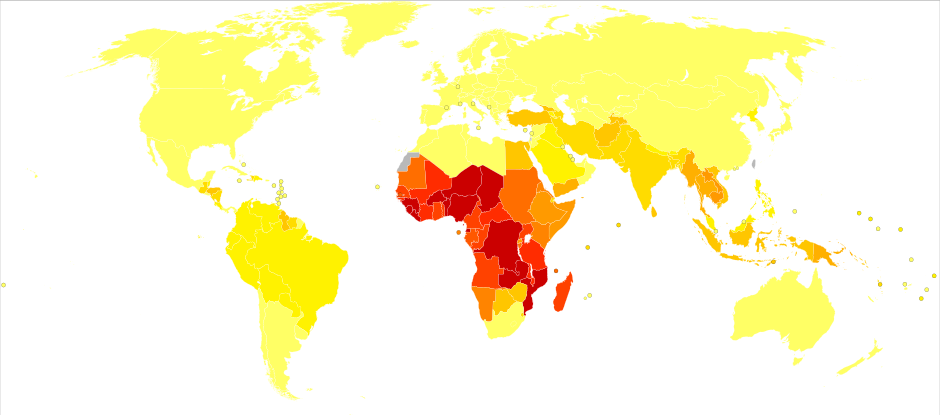
On April 25, 2011, the United Nations observed World Malaria Day by setting an ambitious goal: zero malaria deaths by 2015. Few diseases have contributed more to the misery of mankind than malaria has. At its apex in the 19th century, malaria was responsible for over half of all deaths in some of the hardest hit nations like India, and was endemic to temperate and tropical zones alike. Over the last 150 years, dramatic progress has been made. Malaria has been completely vanquished in the United States and Europe, and sharply reduced in Latin America and South Asia. But Sub-Saharan Africa remains a problem, as it tragically does for many infectious diseases. Today, malaria still kills nearly a million people per year. It is responsible for 20% of all child fatalities in Africa, making it the second-biggest killer in Africa behind HIV/AIDS. Even these high figures probably underestimate malaria’s true consequences, because one of the symptoms of malaria is to weaken the immune system and increase the viral load of diseases such as HIV/AIDS. The disease also makes it difficult for nations to escape poverty; developmental economists John Gallup and Jeffrey Sachs estimate that economic growth is reduced by 1.3% per year in countries with widespread malaria.

Why has malaria remained so troublesome in Africa, even while declining elsewhere? Malaria has always been a disease of poverty. In impoverished countries, many makeshift homes do not have screens, doors, or windows to keep mosquitoes out. Additionally, poor people are often unable to afford malaria treatment, which can cost the equivalent of several months of income in some African nations. If it is left untreated, malaria does not simply run its course and disappear from the body like many diseases do. Instead, it goes into dormancy and can strike again months later. Malaria can become a chronic, lifelong problem for some of its victims who do not have access to treatment. In societies in which a large fraction of the population carries malaria (even if it is dormant), mosquitoes are more likely to acquire the disease each time they bite, and therefore more likely to transmit the affliction to new victims.

In spite of the depressing facts surrounding malaria, there is good reason to believe that malaria can be eradicated in the near future. The UN’s goal is probably overly ambitious, but perhaps only by a few years. A number of trends are converging to make it possible to eliminate the disease. The use of mosquito bed nets has become much more common in many African nations. In Rwanda, 56% of young children now sleep under a bed net, compared to just 4% a decade ago. In Kenya, 46% do so, up from just 3% a decade ago. The mosquitoes which carry malaria tend to be nocturnal and prefer to bite indoors, which is why insecticide-coated bed nets are so effective. Those who use bed nets are only half as likely to get malaria as those who do not. It is likely that within the next couple years, many African nations will have enough bed nets to cover their entire at-risk population.

In 2007, the World Health Organization announced its intentions to resume spraying DDT in malaria-endemic countries. Once the scourge of environmentalists, the chemical was banned in the late 1960s. However, it is still the most potent known insecticide. Many scientists now believe that DDT’s harmful effects may have been overstated, and in any case, eradicating malaria is a higher priority. The spraying of DDT to fight malaria is now supported by many prominent green groups, including the Sierra Club and Environmental Defense.

The cost of treating malaria victims is quickly dropping, offering hope that soon medication will be affordable to people in Sub-Saharan Africa. An initiative by European governments, called the Affordable Medicines Facility for Malaria, aims to reduce the cost of treatment through a combination of concessions and price reductions from pharmaceutical companies, subsidies from European governments, and donations from the private sector to reduce the cost of antimalarial medication to just 5 cents. The effort is already paying off; production of antimalarial medicine has risen from 5 million doses in 2004 to 160 million doses in 2009. Curing people quickly helps the victim and society alike; if people are quickly treated, mosquitoes will be less likely to acquire the malaria parasite each time they bite, and therefore less likely to transmit the disease to others.

Additionally, the search may finally be drawing to a close for the elusive malaria vaccine. In 2009 and 2010, scientists tested a vaccine among several hundred children in Mali. It proved to be effective at preventing malaria for at least one year, although additional tests will need to be conducted before the vaccine can be manufactured for public use.

The widespread use of bed nets, the resumption of DDT spraying, the increasing availability of treatment for victims, and the emergence of a possible vaccine are all coming together simultaneously to make it possible to rid the world of malaria once and for all.

Although the overall prevalence of malaria remains high, these figures mask an important insight: efforts to eradicate malaria are subject to a positive feedback loop. Once the number of infected people (or infected mosquitoes) drops below a certain threshold, it will be more difficult for additional people to become infected, which will reduce the number of infected people and infected mosquitoes even more. This will cause the malaria parasite population to crash, and can occur very quickly. The history of malaria in the United States is a good example of this. In the 1940s, malaria was still common in much of the southern United States, especially in the Mississippi Valley. In 1946, the Center for Disease Control was established with the explicit goal of eradicating malaria. A mere five years later, the disease was gone.

Will the World Health Organization be able to replicate this achievement in Africa, and meet the UN's goal of zero malaria deaths by 2015? I think that's a few years too optimistic. But due to the rapid reduction in malaria and the positive feedback loop which will aid eradication efforts, it isn't implausible. In 2005, the World Health Organization estimated that there were 350-500 million cases of malaria, but just a year later the number of cases had fallen to 247 million. By 2009, there were only 82 million cases. Such a rapid dropoff indicates that malaria is indeed in terminal decline. By the end of this decade, malaria can be rare or extinct, rather than the scourge that it is today.

PREDICTIONS:

By 2020 - There are fewer than 5 million cases of malaria annually, and fewer than 15,000 deaths.

Sunday, October 10, 2010

Update on Driverless Cars

A few months ago, I wrote about self-driving cars. At the time, the last information publicly available came from 2007, in which the DARPA Urban Challenge demonstrated the possibility of cars that could safely navigate through a city without human interference. At the time, only 6 of the 11 autonomous cars that competed in the challenge were able to complete a course in a makeshift "city" on an unused military base. The vehicles traveled extremely slowly (about 13 miles per hour) and the course was only 50 miles long. There were no tricks, surprises, or unusual circumstances...the vehicles just had to drive themselves and react to normal traffic.

I was excited at even this rudimentary amount of progress in 2007, so I was even more delighted when the New York Times provided an update on self-driving cars yesterday. The technology has progressed immensely in the last three years, much more quickly than I would have guessed. Google has secretly been testing autonomous vehicles, working with none other than Sebastian Thrun, the lead engineer of the Stanford Racing Team, which took second place in the DARPA Urban Challenge, and first place in the 2005 DARPA Grand Challenge. The cars have been driving on actual highways, city streets, and rural roads in California, navigating their way through real traffic. There is always a human sitting behind the wheel who has the power to override the self-driving computer, just in case something goes wrong. In the last year, the Google Cars have driven over 1,000 miles on the streets of California without any assistance, and 140,000 miles with only minimal human assistance. They no longer travel at crawling speeds; Google has programmed the speed limits of all the relevant streets into the system and the vehicles are capable of traveling at the speed limit. In the Google Car fleet, there has only been one minor mishap in the last year: when another driver rear-ended a Google Car at a stoplight.

The New York Times article implies that it will be about eight years before self-driving cars are publicly available. Given the unpredictable nature of technological roadblocks and legislative paralysis, I'm opting to be a little more conservative, standing by my previous estimate: they'll be on the roads no later than 2020.

The NYT is quite bullish on their prospects, implying (via technologists and futurists) that "they can transform society as profoundly as the Internet has." That may be a bit of an exaggeration, but only because the Internet has transformed so much of our society. I do not think it is an exaggeration to say that self-driving cars will fundamentally alter the way in which we design cities, will reduce the annual automobile fatalities nationwide from approximately 40,000 to approximately zero, will greatly reduce traffic and pollution, will help alleviate poverty by eliminating the need for most people to own a personal car (instead you could summon one to pick you up like a taxi, but available in non-urban areas and without the high fees), and will allow us to enjoy our commutes more by freeing up our time to do things other than watch the road.

PREDICTIONS:
By 2020 - Driverless cars are commercially-available and street-legal somewhere in the United States.
By 2027 - New driverless cars outnumber new cars requiring at least some human control, in the US market.
By 2035 - Driverless cars are widely perceived as safer than human drivers. Somewhere in the United States, it is illegal for humans to drive.

Thursday, May 20, 2010

Climate Change Solutions and Non-Solutions

The climate change debate in the United States seems to perpetually focus on the wrong questions. Some deny that climate change even exists, while others claim climate change may reach a “tipping point” which would permanently cause a drastic shift in the earth’s climate. The economic aspects of the debate are usually drowned out entirely, but they are important to consider when formulating public policy. How much will it cost to fight climate change? Will our efforts to combat climate change actually be effective? And would it be better to simply wait a few years for better technology?

Climate change is, of course, a real danger to our planet, but our ability to reduce our impact at the present time is very limited. First, there is the economic problem. Even if the developed world unilaterally limited its carbon emissions, the developing world almost certainly would not follow suit, thus negating any carbon reductions in the West. From the perspective of developing nations, the economic imperatives of developing as quickly as possible simply outweigh the environmental risks of global warming. China and India have successfully lifted hundreds of millions of people out of poverty through economic development; it is highly unlikely that they will be willing to acquiesce to Western demands to limit their carbon emissions (and thus limit their economic growth). With such a strong economic incentive to continue polluting, finding the political will to limit emissions will be almost impossible for these nations.

Second, there is the technological problem. Carbon dioxide stays in the atmosphere for 70 years. If the entire world suddenly reverted to the amount of carbon emissions they produced in 1990, the net impact on our climate would be almost negligible by the end of the 21st century. Programs like cap-and-trade are doomed to failure, due to both the political difficulty of implementing them and their lack of effectiveness at actually halting climate change. Therefore, any feasible solution must come from technology, not politics.

We need not accept the punishment Mother Nature will dole out for our meddling with the environment. On the contrary, I am optimistic about technological solutions on the horizon. Solar energy is following a Moore’s Law-like trajectory, with the cost falling by half every 2-3 years. Within 10 to 15 years, solar energy will be cheaper than oil. Switching from fossil fuels to clean energy will be the single biggest way to end our carbon pollution.

Additionally, many geoengineering solutions have been proposed to scrub the existing carbon dioxide from the atmosphere. One of the most feasible ideas is called iron fertilization, in which we would seed the oceans with small flakes of iron to encourage plankton to grow, which would in turn “eat” carbon dioxide. Geoengineering solutions like this could be implemented today, and are very cheap. However, they carry environmental dangers of their own, and it remains to be seen if the good would outweigh the bad. Environmental scientists are studying the side effects of these solutions, and it should be clearer within a few years if the consequences of these solutions will be acceptable.

In the very near future, it is likely that we will have some cost-effective, feasible solutions for effectively limiting our carbon pollution, without the economic downsides of cap-and-trade or international treaties. However, they are not available quite yet, and we should not pretend that they are by wasting money on anti-global warming initiatives instead of spending the money on something that can actually help the world today. While I realize this suggestion does not fulfill our emotional need to pretend that we are doing something to solve the problem, doing nothing is the only rational course of action...for now.

Saturday, May 8, 2010

The Future of Automobiles - Driverless Cars

In 2007, the Defense Advanced Research Projects Agency (DARPA) sponsored an event called the Urban Challenge. Recognizing the utility of self-driving vehicles for military purposes, DARPA invited 11 teams from universities and corporations to build vehicles that would be able to navigate a course through a makeshift city without any human interference. Furthermore, the teams would have to obey all the traffic laws and avoid any collisions with other vehicles, buildings, or obstacles. Six of the teams were able to complete the contest, led by Carnegie Mellon University.

The most successful self-driving cars use cameras and lasers mounted on every side of the car to “see” their surroundings, and send the images to a computer in the car to process them in real time. The technology has already advanced to the point where computers can read road signs, detect other fast-moving objects (like cars), and generally obey the traffic laws. General Motors has announced that they will start testing driverless vehicles in 2015, and hopes to have them on the road by 2018.

The biggest technical obstacle that still needs to be overcome involves dealing with unexpected situations. The driverless car prototypes, such as Carnegie Mellon’s vehicle “Boss,” are fairly good at recognizing and obeying stop signs and traffic lights. However, these vehicles are built with the assumption that all other cars on the road will obey the laws as well. Most humans can hit the brakes if another car runs a red light or if an animal runs out in front of our car, but unfortunately the driverless cars are not quite there yet. However, with the speed at which driverless technology is progressing, it seems very likely that this problem will be overcome in the next few years, and self-driving cars will be able to react at least as well as human drivers.

The impact that driverless cars will have on society will be nothing less than transformative. The biggest revolutions will occur in safety and lifestyle.

In the United States, over 40,000 people are tragically killed each year in car accidents, 95% of which are due to human error. Driverless cars thus offer us the opportunity to save 38,000 lives every year. When the technology matures, the computerized systems in our cars will have reflexes thousands of times quicker than human drivers, and will be able to scan all around the car at all times to identify any potential dangers.

Driverless cars will also improve our lifestyle, by reducing commute times. Driverless cars will be able to identify any road delays via the internet, and plan an alternate route to avoid getting stuck in traffic. Furthermore, when driverless cars become ubiquitous, there will be no need for individuals to own cars. When cars can drive themselves, why would I spend thousands of dollars on a car that will sit unused in a garage or parking lot for most of the day? It would be much more efficient for cities to develop networks of public cars that could drive themselves to pick people up as needed. If I needed to go across town, I could use my phone to order the nearest car to pick me up. If I needed a car to pick me up at the same place and time every day (such as for my morning commute to work), I could schedule this as well. These networks of driverless cars could operate similar to taxi cabs, but much more efficiently, safely, and cheaply.

The biggest long-term obstacles to driverless cars are liability laws. While driverless cars could save up to 38,000 lives per year that would otherwise be lost due to human error, what happens if 1,000 lives are lost due to computer error? Under our present liability system, the auto manufacturers would lose their shirts. Unless these laws are changed, it will be extremely difficult from an economic standpoint for auto companies to roll out self-driving vehicles in the United States for commercial use.

I am optimistic that this problem can be overcome. As soon as the utility of driverless cars becomes clear (probably by 2015-2020), there will likely be a legislative push to limit the liability for auto manufacturers. When that happens, we will enter the era of automated transportation and the world will be forever changed.

PREDICTIONS:
By 2020 - Driverless cars are commercially-available and street-legal somewhere in the United States.
By 2027 - New driverless cars outnumber new cars requiring at least some human control, in the US market.
By 2035 - Driverless cars are widely perceived as safer than human drivers. Somewhere in the United States, it is illegal for humans to drive.