Showing posts with label aids. Show all posts

Monday, May 30, 2011

How to Eradicate Malaria

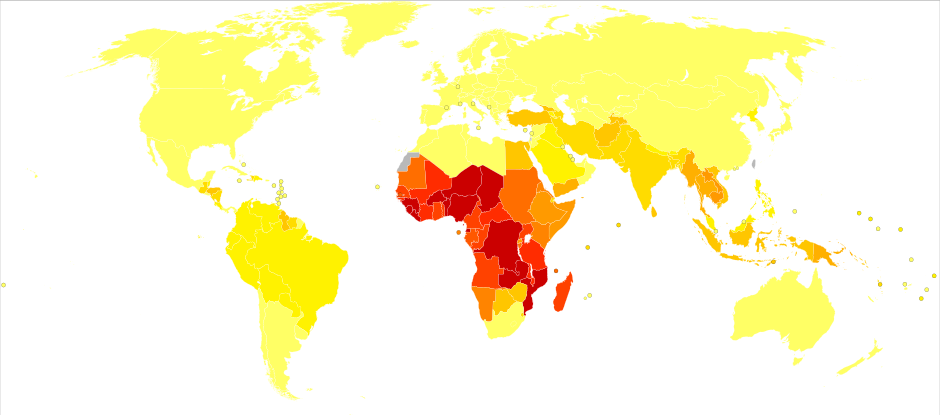
On April 25, 2011, the United Nations observed World Malaria Day by setting an ambitious goal: zero malaria deaths by 2015. Few diseases have contributed more to the misery of mankind than malaria has. At its apex in the 19th century, malaria was responsible for over half of all deaths in some of the hardest hit nations like India, and was endemic to temperate and tropical zones alike. Over the last 150 years, dramatic progress has been made. Malaria has been completely vanquished in the United States and Europe, and sharply reduced in Latin America and South Asia. But Sub-Saharan Africa remains a problem, as it tragically does for many infectious diseases. Today, malaria still kills nearly a million people per year. It is responsible for 20% of all child fatalities in Africa, making it the second-biggest killer in Africa behind HIV/AIDS. Even these high figures probably underestimate malaria’s true consequences, because one of the symptoms of malaria is to weaken the immune system and increase the viral load of diseases such as HIV/AIDS. The disease also makes it difficult for nations to escape poverty; developmental economists John Gallup and Jeffrey Sachs estimate that economic growth is reduced by 1.3% per year in countries with widespread malaria.

Why has malaria remained so troublesome in Africa, even while declining elsewhere? Malaria has always been a disease of poverty. In impoverished countries, many makeshift homes do not have screens, doors, or windows to keep mosquitoes out. Additionally, poor people are often unable to afford malaria treatment, which can cost the equivalent of several months of income in some African nations. If it is left untreated, malaria does not simply run its course and disappear from the body like many diseases do. Instead, it goes into dormancy and can strike again months later. Malaria can become a chronic, lifelong problem for some of its victims who do not have access to treatment. In societies in which a large fraction of the population carries malaria (even if it is dormant), mosquitoes are more likely to acquire the disease each time they bite, and therefore more likely to transmit the affliction to new victims.

In spite of the depressing facts surrounding malaria, there is good reason to believe that malaria can be eradicated in the near future. The UN’s goal is probably overly ambitious, but perhaps only by a few years. A number of trends are converging to make it possible to eliminate the disease. The use of mosquito bed nets has become much more common in many African nations. In Rwanda, 56% of young children now sleep under a bed net, compared to just 4% a decade ago. In Kenya, 46% do so, up from just 3% a decade ago. The mosquitoes which carry malaria tend to be nocturnal and prefer to bite indoors, which is why insecticide-coated bed nets are so effective. Those who use bed nets are only half as likely to get malaria as those who do not. It is likely that within the next couple years, many African nations will have enough bed nets to cover their entire at-risk population.

In 2007, the World Health Organization announced its intentions to resume spraying DDT in malaria-endemic countries. Once the scourge of environmentalists, the chemical was banned in the late 1960s. However, it is still the most potent known insecticide. Many scientists now believe that DDT’s harmful effects may have been overstated, and in any case, eradicating malaria is a higher priority. The spraying of DDT to fight malaria is now supported by many prominent green groups, including the Sierra Club and Environmental Defense.

The cost of treating malaria victims is quickly dropping, offering hope that soon medication will be affordable to people in Sub-Saharan Africa. An initiative by European governments, called the Affordable Medicines Facility for Malaria, aims to reduce the cost of treatment through a combination of concessions and price reductions from pharmaceutical companies, subsidies from European governments, and donations from the private sector to reduce the cost of antimalarial medication to just 5 cents. The effort is already paying off; production of antimalarial medicine has risen from 5 million doses in 2004 to 160 million doses in 2009. Curing people quickly helps the victim and society alike; if people are quickly treated, mosquitoes will be less likely to acquire the malaria parasite each time they bite, and therefore less likely to transmit the disease to others.

Additionally, the search may finally be drawing to a close for the elusive malaria vaccine. In 2009 and 2010, scientists tested a vaccine among several hundred children in Mali. It proved to be effective at preventing malaria for at least one year, although additional tests will need to be conducted before the vaccine can be manufactured for public use.

The widespread use of bed nets, the resumption of DDT spraying, the increasing availability of treatment for victims, and the emergence of a possible vaccine are all coming together simultaneously to make it possible to rid the world of malaria once and for all.

Although the overall prevalence of malaria remains high, these figures mask an important insight: efforts to eradicate malaria are subject to a positive feedback loop. Once the number of infected people (or infected mosquitoes) drops below a certain threshold, it will be more difficult for additional people to become infected, which will reduce the number of infected people and infected mosquitoes even more. This will cause the malaria parasite population to crash, and can occur very quickly. The history of malaria in the United States is a good example of this. In the 1940s, malaria was still common in much of the southern United States, especially in the Mississippi Valley. In 1946, the Center for Disease Control was established with the explicit goal of eradicating malaria. A mere five years later, the disease was gone.

Will the World Health Organization be able to replicate this achievement in Africa, and meet the UN's goal of zero malaria deaths by 2015? I think that's a few years too optimistic. But due to the rapid reduction in malaria and the positive feedback loop which will aid eradication efforts, it isn't implausible. In 2005, the World Health Organization estimated that there were 350-500 million cases of malaria, but just a year later the number of cases had fallen to 247 million. By 2009, there were only 82 million cases. Such a rapid dropoff indicates that malaria is indeed in terminal decline. By the end of this decade, malaria can be rare or extinct, rather than the scourge that it is today.

PREDICTIONS:

By 2020 - There are fewer than 5 million cases of malaria annually, and fewer than 15,000 deaths.

Wednesday, September 15, 2010

Black Swan Events: Bioterrorism

The Genomic Revolution is a double-edged sword. As I mentioned previously, the benefits will be enormous. Genomics will allow us to have personalized, preventative health care, instead of mass-market sick care. However, there is also a ghastly dark side to the Genomic Revolution. We will soon face the truly horrifying prospect of bioterror (or bioerror.) When any college student has access to pathogens and the capability to modify them to make them even more virulent or transmissible, someone almost certainly will.

Within a few years, the genomes of nearly all human pathogens will be publicly available. This will be necessary in order to better understand these diseases and develop cures. However, those who wish to use this information to commit acts of mass murder will have access to it as well. Some diseases may not require very much modification to become even more deadly. The 1918 Spanish flu pandemic, which killed more people than World War I, is very genetically similar to many of the strains of flu that are still circulating to this day. Soon it will be possible for an individual to create a virulent flu strain like the Spanish flu by genetically modifying other strains.

Since genomics is essentially an information technology, it is possible to swap genes from one species into another. This is what allows agronomists to copy the cold-resistant genes of Arctic fish and paste them into tomatoes (in theory.) However, the same principle could be used by bioterrorists to create a Frankenstein’s monster, combining the worst traits of many diseases. Imagine an illness with the virulence of ebola, the transmissibility of the common cold, and the evolutionary adaptability of HIV. Such a disease is the stuff that nightmares (or B-movies) are made of. Yet it will eventually be possible for malevolent individuals or groups to create them.

If a manmade disease was sufficiently different from anything found in nature, it could prove devastating. We humans have had a chance to evolve alongside influenza, the plague, malaria, and other naturally-occurring afflictions. People alive today are mostly descended from the hearty individuals who survived earlier strains of these diseases. But we would not have evolved such immunities to manmade diseases. Just as the vast majority of Native Americans were decimated by European diseases to which they had no immunity in the 16th century, we could face the same prospect with manmade superplagues.

Fortunately, we have a defensive weapon in our arsenal that the 16th century Native Americans did not have. Just as genomics can create such frightening diseases, it holds the potential to cure them. Within a few years, it will be possible to sequence a genome in a couple hours. As our understanding of how genes work continues to grow, it will take less and less time to understand the genomes we sequence. Assuming that bureaucratic procedures were waived to combat a public health emergency, a cure for a manmade disease could be on the market almost as quickly as software antivirus programs are patched when new threats are discovered. Soon, naturally-occurring diseases could be a mere minor annoyance. The real public health danger could shift to the arms race between bioterrorists and scientists racing to cure their latest concoctions.

BLACK SWAN EVENTS:

By 2040 – A disease created or modified by humans has been released into the public. Probability: 90%

By 2040 – A disease created or modified by humans has killed at least 100,000 people. Probability: 75%

(I hesitated to even call bioterrorism a “Black Swan,” since that implies that the event is at least somewhat unlikely to occur. In my opinion, the danger of manmade diseases being released onto the public is not a question of if, but when and where. Since we cannot forecast this, it is unpredictable enough to be considered a Black Swan Event in my opinion.)

Friday, May 28, 2010

Black Swans


When predictions about the future are incorrect, it is often because the predictor assumed that history wouldn’t provide us with any surprises, which it almost invariably does. Nassim Nicholas Taleb refers to these events as black swans. It is extremely difficult to predict them in advance, but they have a drastic impact on world history. Examples include 9/11, the AIDS pandemic, the Islamic Revolution in Iran, the invention of nuclear weapons, the stock market crash of 1929, the 1918 Spanish Flu pandemic, or the outbreak of World War I.

You may notice that most of the events on this list are widely considered to be disasters. As Warren Buffett has said, “Surprises are nearly always bad.” However, this isn’t universally true. There are, on rare occasions, examples of positive black swan events.

For example, in 1968 Paul Ehrlich wrote The Population Bomb, which predicted a nightmarish future of overpopulation and mass famine. Ehrlich looked at the global population trends from recent decades and saw that people were reproducing at an alarmingly fast rate. Yet within just a few years of the book’s publication, global birth rates began to decline and the global food supply increased exponentially. Ehrlich completely missed two very important “positive” black swans: The widespread adoption of the birth control pill and the Green Revolution in India.

The purpose of thinking about potential black swan events is to plan for events that are individually unlikely to occur, but would have a profound impact on the world if they do. I’ve thought of a few black swan events to think about for the next decade:

• A nuclear war between India and Pakistan
• The democratization or fragmentation of China
• Ecological collapse, followed or preceded by abrupt climate change
• Bioterror or bioerror releases a manmade super-plague
• The invention of effective anti-aging medicine offers indefinite lifespans
• The assassination of a major world leader
• An especially nasty strain of avian or swine flu results in a global pandemic
• An American state votes to secede from the union
• A global financial collapse

Depressing, huh? I tend to agree with Buffett that surprises tend to be bad (with some exceptions). Positive events tend to be much more incremental and predictable than negative events. You may believe the events on my list are all unlikely to occur in the next decade, as I do, but that’s the whole point. We must anticipate unlikely events and make contingency plans in case they occur. Life's surprises can be just as important as its long-term trends.

What do you think are some other black swan events that could conceivably occur in the next decade?