Monday, May 30, 2011

How to Eradicate Malaria

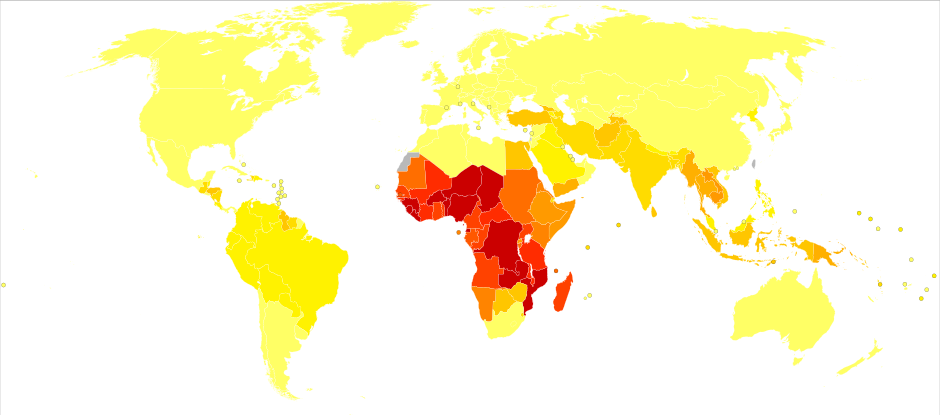
On April 25, 2011, the United Nations observed World Malaria Day by setting an ambitious goal: zero malaria deaths by 2015. Few diseases have contributed more to the misery of mankind than malaria has. At its apex in the 19th century, malaria was responsible for over half of all deaths in some of the hardest hit nations like India, and was endemic to temperate and tropical zones alike. Over the last 150 years, dramatic progress has been made. Malaria has been completely vanquished in the United States and Europe, and sharply reduced in Latin America and South Asia. But Sub-Saharan Africa remains a problem, as it tragically does for many infectious diseases. Today, malaria still kills nearly a million people per year. It is responsible for 20% of all child fatalities in Africa, making it the second-biggest killer in Africa behind HIV/AIDS. Even these high figures probably underestimate malaria’s true consequences, because one of the symptoms of malaria is to weaken the immune system and increase the viral load of diseases such as HIV/AIDS. The disease also makes it difficult for nations to escape poverty; developmental economists John Gallup and Jeffrey Sachs estimate that economic growth is reduced by 1.3% per year in countries with widespread malaria.

Why has malaria remained so troublesome in Africa, even while declining elsewhere? Malaria has always been a disease of poverty. In impoverished countries, many makeshift homes do not have screens, doors, or windows to keep mosquitoes out. Additionally, poor people are often unable to afford malaria treatment, which can cost the equivalent of several months of income in some African nations. If it is left untreated, malaria does not simply run its course and disappear from the body like many diseases do. Instead, it goes into dormancy and can strike again months later. Malaria can become a chronic, lifelong problem for some of its victims who do not have access to treatment. In societies in which a large fraction of the population carries malaria (even if it is dormant), mosquitoes are more likely to acquire the disease each time they bite, and therefore more likely to transmit the affliction to new victims.

In spite of the depressing facts surrounding malaria, there is good reason to believe that malaria can be eradicated in the near future. The UN’s goal is probably overly ambitious, but perhaps only by a few years. A number of trends are converging to make it possible to eliminate the disease. The use of mosquito bed nets has become much more common in many African nations. In Rwanda, 56% of young children now sleep under a bed net, compared to just 4% a decade ago. In Kenya, 46% do so, up from just 3% a decade ago. The mosquitoes which carry malaria tend to be nocturnal and prefer to bite indoors, which is why insecticide-coated bed nets are so effective. Those who use bed nets are only half as likely to get malaria as those who do not. It is likely that within the next couple years, many African nations will have enough bed nets to cover their entire at-risk population.

In 2007, the World Health Organization announced its intentions to resume spraying DDT in malaria-endemic countries. Once the scourge of environmentalists, the chemical was banned in the late 1960s. However, it is still the most potent known insecticide. Many scientists now believe that DDT’s harmful effects may have been overstated, and in any case, eradicating malaria is a higher priority. The spraying of DDT to fight malaria is now supported by many prominent green groups, including the Sierra Club and Environmental Defense.

The cost of treating malaria victims is quickly dropping, offering hope that soon medication will be affordable to people in Sub-Saharan Africa. An initiative by European governments, called the Affordable Medicines Facility for Malaria, aims to reduce the cost of treatment through a combination of concessions and price reductions from pharmaceutical companies, subsidies from European governments, and donations from the private sector to reduce the cost of antimalarial medication to just 5 cents. The effort is already paying off; production of antimalarial medicine has risen from 5 million doses in 2004 to 160 million doses in 2009. Curing people quickly helps the victim and society alike; if people are quickly treated, mosquitoes will be less likely to acquire the malaria parasite each time they bite, and therefore less likely to transmit the disease to others.

Additionally, the search may finally be drawing to a close for the elusive malaria vaccine. In 2009 and 2010, scientists tested a vaccine among several hundred children in Mali. It proved to be effective at preventing malaria for at least one year, although additional tests will need to be conducted before the vaccine can be manufactured for public use.

The widespread use of bed nets, the resumption of DDT spraying, the increasing availability of treatment for victims, and the emergence of a possible vaccine are all coming together simultaneously to make it possible to rid the world of malaria once and for all.

Although the overall prevalence of malaria remains high, these figures mask an important insight: efforts to eradicate malaria are subject to a positive feedback loop. Once the number of infected people (or infected mosquitoes) drops below a certain threshold, it will be more difficult for additional people to become infected, which will reduce the number of infected people and infected mosquitoes even more. This will cause the malaria parasite population to crash, and can occur very quickly. The history of malaria in the United States is a good example of this. In the 1940s, malaria was still common in much of the southern United States, especially in the Mississippi Valley. In 1946, the Center for Disease Control was established with the explicit goal of eradicating malaria. A mere five years later, the disease was gone.

Will the World Health Organization be able to replicate this achievement in Africa, and meet the UN's goal of zero malaria deaths by 2015? I think that's a few years too optimistic. But due to the rapid reduction in malaria and the positive feedback loop which will aid eradication efforts, it isn't implausible. In 2005, the World Health Organization estimated that there were 350-500 million cases of malaria, but just a year later the number of cases had fallen to 247 million. By 2009, there were only 82 million cases. Such a rapid dropoff indicates that malaria is indeed in terminal decline. By the end of this decade, malaria can be rare or extinct, rather than the scourge that it is today.

PREDICTIONS:

By 2020 - There are fewer than 5 million cases of malaria annually, and fewer than 15,000 deaths.

Monday, April 4, 2011

Book Review - "Disrupting Class" by Clayton Christensen

Clayton Christensen’s book, Disrupting Class, is a fascinating look at how disruptive new technologies will soon transform the dismal state of the American education system. By far, the most intriguing aspect is the potential for online education to completely upend traditional schools and dramatically improve education.

Some of the biggest problems with schools are often lost in the contentious political debates over teachers’ unions, vouchers, and merit pay. Often, the underlying problems are completely ignored because they seem intractable. The traditional classroom model – where one teacher instructs 25 students – is antiquated and ineffective at addressing students’ needs. As Disrupting Class illustrates, each student has unique learning styles and abilities, which are completely ignored in traditional schools.

In brick-and-mortar schools, where there are vastly more students than teachers, education cannot be customized to individual students. The instructor tries his or her best to teach according to the learning style that reaches the most students, but those who march to the beat of a different drum inevitably fall through the cracks. Classes invariably move at the same pace despite the fact that students do not learn at the same pace. An instructor teaches a unit, the students are tested on the material, and the entire class moves on to the next unit, regardless of the performance of individual students. As a result, the advanced students are bored in school and want to move faster, while the struggling students fall farther and farther behind as their knowledge deficiencies accumulate.

Disrupting Class envisions a future where these things are no longer problems, due to interactive online education that is far better than today’s education software, which far too often is nothing more than glorified flash cards. In the online classes of the future, each student will be able to learn at his or her own pace, and won’t advance to the next unit until he or she has mastered the material from the current one. The concept of awarding letter grades for classes might be replaced by measuring how long it takes a student to earn an A.

Additionally, online education will allow for classes to be customized to the student’s particular learning style. The debates over whether one particular teaching style is better than another, or whether charter schools are better than traditional schools, will vanish. When each student can learn the material in a manner tailored to his or her own needs, we will finally recognize that no single teaching style or type of school is best for all students.

Although the book primarily focuses on the American education system, the international implications of disruptive education technology are possibly even more profound. Salman Khan, the founder of the Khan Academy, stressed this point in his recent TED Talk. Online education offers the possibility to turbo-charge the human development of countries where access to education is still a problem. Far too many children in the slums of developing countries have little access to education of any kind. The proliferation of online education – which should roughly coincide with the proliferation of smartphones and tablets in much of the developing world – will open up vast new worlds of information to students in the most remote parts of the planet, where local teachers are unavailable, unknowledgeable, or expensive.

Disrupting Class gets its name because, in Christensen’s view, these educational innovations will largely take place outside of traditional classrooms, and eventually supplant them entirely. In the infancy of online education, teachers will use online education to supplement their in-class curriculum, or use it to allow students to take classes that are not offered at the school. Over time, education software will play a larger and larger role in classrooms until the schools themselves are no longer necessary. Students might continue to gather with their local friends in a building called a “school” to learn, but classes will be determined by learning style, ability, and personal interests rather than by school district. Teachers will instruct students entirely via computer.

How long will it take until online education is widely adopted? Not long, by Christensen’s estimate. He notes that online education is following the same adoption pattern of many other disruptive technologies, such as digital photography, which start off very slowly but suddenly become dominant once they reach critical mass. According to Christensen, in the United States in 2000 there were 1,000 students in classrooms for every 1 online learner. By 2007, this ratio had dropped to 100 to 1. If this trend continues, online learning will command a sizable chunk of the market (10%) by 2014, and gain a majority by 2019. Shortly thereafter, our 170-year-old model of classroom-based learning will come to an end.

Projections from "Disrupting Class" by Clayton Christensen

My sole criticism of the book is that it is a bit too broad. Christensen primarily focuses on online education, but devotes short sections to other innovations like new methods of evaluating teaching styles, and teaching highschoolers the necessary parenting skills they will need to one day raise successful children of their own. Although these are certainly interesting ideas worth exploring, they felt a bit out of place in a book primarily about the disruptive nature of education technology. I would have liked to see these chapters replaced with more information about online education, which is, after all, the main focus of the book.

Disrupting Class is thought-provoking and charts a very plausible course for would-be developers of online education tools. The future of education will inevitably be online. The advantages are just too numerous to ignore.

4/5 stars

Thursday, March 31, 2011

Space Travel: Science Fiction's Biggest Underachiever

In 1968, futurist Arthur C. Clarke wrote 2001: A Space Odyssey, which quickly became one of the most popular science fiction novels of the 20th century. In Clarke’s vision of tomorrow, mankind in 2001 would have ring-shaped space stations that rotate to provide gravity, permanent lunar colonies which people routinely visit for business meetings, and fully-functional (if evil) artificial intelligence. The zeitgeist of the late 1960s, at the height of the space race, was one of unbridled optimism in the future of space travel. Just two years before Clarke’s novel was published, Star Trek had first premiered. It seemed inevitable that we were destined for the stars.

Looking at the world around us, it is easy to be disappointed at how space travel has progressed. The world today looks nothing like Star Trek, or even 2001: A Space Odyssey. After the Apollo missions ended in 1972, something strange happened that few futurists anticipated: mankind stopped exploring space, and turned inward to focus on problems at home. NASA’s budget was slashed. To the extent that space exploration progressed, it was done almost exclusively by robots rather than manned missions. If we were able to go back in time to the late 1960s and tell people that we would indeed have a permanent space settlement today, they would almost certainly envision something far grander than the International Space Station.

Why were the space enthusiasts wrong? The biggest obstacle has been political, not technological. In my opinion, political trends are much more difficult to predict than technological trends. From a 1968 perspective, the US and USSR were locked in a Cold War that would soon extend far above the earth’s surface. It was much easier to forecast the trends in space technology than to predict that the USSR would throw in the towel on the space race by the mid-1970s, and cease to exist at all soon thereafter. With the collapse of the USSR, the impetus for a space race has disappeared. No nation is willing to spend large sums of money exploring space without the threat of a rival beating them to it.

In light of this political reality, the exploration of other worlds seems to be permanently on hold. I do not envision this changing any time in the next couple decades. Although President George W. Bush called for the United States to return to the moon by 2020 and NASA stated that a permanent manned lunar base would be operational by 2024, it is highly unlikely that these goals will be fulfilled. The US is simply not motivated to do so.

Additionally, the economics of space travel have changed significantly since the Apollo missions. Due to advances in computer technology, it is now much cheaper to send robots to explore other worlds than it is to send human astronauts. Robots don’t need food, water, and air to keep them alive, and don’t need a return trip to earth. They can do almost everything a human astronaut can do, and can wirelessly transmit the data back home. Indeed, NASA has had some great achievements exploring our solar system, but the pioneers have all been robots.

It is possible that the private sector will be able to pick up part of the slack left by governments. SpaceShipOne, the first privately-owned spacecraft, claimed the Ansari X Prize in 2004. However, private space travel will never progress beyond orbital missions for super-rich adventure-seekers until there are some fundamental breakthroughs in rocketry. It currently costs $10,000 to send one pound into orbit, because rocket fuel itself is responsible for 90% of the weight of a rocket. As long as fossil fuels are the standard propulsion technology, human space travel will continue to be unaffordable for most people. Futurist and theoretical physicist Michio Kaku suggests that rockets could be powered by lasers instead of by fuel. Lasers on earth could fire at a water tank, vaporizing the water and propelling a rocket upward. Since the thrust would come from the ground instead of the rocket itself, it would eliminate the need for fuel and make rocketry 10 times more efficient.

Although this technique has been demonstrated to work in prototypes, it will be a long time before it can be applied to something as large as a rocket. Although many emerging technologies few people have imagined will suddenly take us by surprise, I think that space travel is something that will continue to disappoint us for many years.

PREDICTIONS:

As of 2025 – No human being has set foot on the moon since the Apollo missions.

As of 2035 – No human being has ever set foot on Mars.

Tuesday, February 1, 2011

The Democratic Threshold

In the wake of the collapse of the Soviet Union, futurist and political economist Francis Fukuyama wrote a book in 1992 entitled The End of History and the Last Man, in which he theorized that nearly all nations would soon become liberal democracies. Since all competing global ideologies had been defeated, Fukuyama felt that it was only logical that the people of all nations would soon demand freedom from their leaders and live in peace happily ever after – the end of history. Since 9/11, Fukuyama’s predictions have frequently been derided and ridiculed for such a spectacularly inaccurate and overly-optimistic view of the future.

In light of the democratic revolts currently spreading across the Arab world, Fukuyama’s theory merits reexamination. Was he wrong, or just a few decades premature? Is liberal democracy the inevitable final stage of development, and if so, what kind of conditions are necessary for it to thrive? It’s easy to get swept up in the excitement of the moment – the collapse of communism must have been just as exhilarating to democrats as the (possible) collapse of Arab autocracy is today – but we must bear in mind that the crystal ball is always murky. It is unclear how far the current wave of revolutions will spread, or what the ultimate outcome will be. Charting “the end of history” based on recent current events is never a good idea.

Fortunately, we need not make wide-eyed predictions based upon what we wish were true. There is plenty of statistical data to analyze. The relationship between the economic success of a nation and its level of democracy is very strong. Nearly all countries with a GDP per capita (adjusted for purchasing power parity) of at least $10,000 are at least partially democratic, with the vast majority being full-fledged democracies, as measured by The Economist’s Democracy Index. However, the statistics don’t show us which is the cause and which the effect. Does an affluent society make people more willing to demand their democratic freedoms, or does democracy bring about affluence? There have been many autocracies which have grown their economies very quickly – South Korea in the 1970s, Chile in the 1980s, and China today – but they always seem to democratize around the same time they become wealthy. This suggests to me that an economically empowered people are more likely to demand democratic empowerment; and just as importantly, governments are likely to accede to their demands. In my view, a GDP per capita of $10,000 is a Democratic Threshold. No nation can economically develop past this level without transitioning to at least partial democracy.

But there is one group of countries that is a large exception to this rule. Nate Silver at FiveThirtyEight and Thomas Friedman at Foreign Policy Magazine have both pointed out the toxic effect that oil has on democracy. Indeed, the statistics bear this out. With the exception of Norway and the Netherlands, every oil-rich country (where oil exports account for at least 5% of GDP) is much less democratic than other countries at the same level of development without oil. Qatar may have a higher GDP per capita than the United States, but it is far less democratic. Oil breeds corruption and autocracy.

Taking oil-rich countries out of the mix, I have charted the relationship between democracy and economic development:

A few autocracies are nearing the $10,000 GDP per capita Democratic Threshold. A few others including China are not there yet, but are growing so fast that they will most likely reach it within a decade. Some countries have not reached the Democratic Threshold, but score far lower on The Economist’s Democracy Index than one would expect, given their GDP per capita. Nations falling into these categories are the ones best primed for some serious progress toward democracy. What countries would those be?

Country

GDP per capita (PPP)

Democracy Index

Expected DI

Democracy Deficit

Tunisia

$9,500

2.79

6.15

-3.36

North Korea

$1,800

1.08

4.43

-3.35

Uzbekistan

$3,100

1.74

4.99

-3.25

China

$7,400

3.14

5.89

-2.75

Djibouti

$2,800

2.20

4.89

-2.69

Cuba

$9,900

3.52

6.19

-2.67

Egypt

$6,200

3.07

5.71

-2.64

Laos

$2,400

2.10

4.73

-2.63

Swaziland

$4,500

2.90

5.38

-2.48

Burma

$1,100

1.77

3.92

-2.15

Vietnam

$3,100

2.94

4.99

-2.05

Tajikistan

$2,000

2.51

4.54

-2.03

Guinea-Bissau

$1,100

1.99

3.92

-1.93

Jordan

$5,300

3.74

5.55

-1.81

Fiji

$4,300

3.62

5.33

-1.71


(Disclaimer: Obviously I’m not saying that these countries are all poised to become liberal democracies overnight, merely that there is the potential for substantial progress. North Korea, for example, has set the democratic bar so low that even modest efforts toward democracy would be a major step forward.)

The three Arab states on this list – Tunisia, Egypt, and Jordan – are in the midst of serious challenges to their authority. It’s no coincidence that these three countries, and not other Arab states, are the epicenter of the protests. As I write this, Tunisians have successfully deposed their dictator in the Jasmine Revolution. Egyptian President Hosni Mubarak has declared he will not seek reelection this fall, although his prospects of remaining in power even that long look pretty bleak. Jordan’s enlightened King Abdullah has just dismissed his government and has wisely pledged to institute immediate democratic reforms.

The other countries on this list are an assortment of communist holdouts, rogue nations, and states dominated by a larger power. If China becomes democratic, for example, it could send shockwaves throughout the region and lead to the collapse of North Korea, Burma, and authoritarian regimes throughout Africa, which depend on China for their survival.

Fukuyama’s theory seems to be supported by the statistical evidence - liberal democracy is indeed the end of history. Once countries surpass the Democratic Threshold – approximately $10,000 GDP per capita – they almost invariably develop some form of democracy. Those that make a conscious decision to keep their people impoverished may be less likely to transition to democracy, but economic stagnation can lead to other forms of revolt due to public dissatisfaction. This leads to a paradox for authoritarian governments: They will quickly fall out of favor with the public if they can’t produce a strong economy, but prosperity will ultimately lead to their downfall in the longer term.

I can’t say that I agree with some of Fukuyama’s idealistic, neoconservative foreign policy recommendations for spreading democracy, but I do agree with his idea of “democratic determinism.” Countries without oil are ultimately destined to become democracies as they become wealthy. And even the petro-states have hope. As soon as the world transitions to alternative sources of energy, their economies will no longer be strangled by oil and it will no longer serve as a drag on their freedom. Democracy is coming to a country near you. It’s only a matter of time until we reach the end of history.

PREDICTIONS:

By 2013 – Cuba has made substantial progress toward democracy relative to where it stood at the beginning of 2011.

By 2016 – Tunisia, Egypt, and Jordan have made substantial progress toward democracy relative to where they stood at the beginning of 2011.

By 2018 – China has made substantial progress toward democracy relative to where it stood at the beginning of 2011.

Thursday, January 27, 2011

State of the Union Analysis

President Obama’s 2011 State of the Union address was one of the most future-oriented addresses to Congress in recent memory, despite proposing relatively few new ideas. Although the speech consisted mostly of the same policy recommendations that could have been given by any Democratic politician of the last two decades, the things the president chose to emphasize offer some hints to the direction the United States is heading.

I felt that the first half of the speech dealing with domestic policy was far stronger than the foreign policy section. President Obama hit most of the key policy ideas that will dominate American politics in the coming decades, referring several times to “investing in the future.” As America’s infrastructure crumbles and its education system falls behind that of other nations, viewing this type of spending as an investment rather than an expense is absolutely essential for our future wellbeing. President Obama mentioned his National Broadband Plan for the second year in a row. Although it is a welcome step in the right direction, it is woefully inadequate at meeting the needs of a 21st century economy. If the goals are met, broadband coverage in the United States in 2020 will be about the same as South Korea has today. Additionally, President Obama failed to take a firm stand on net neutrality or wireless carrier oligopolies, which have made the United States one of the least efficient countries in the developed world in telecommunications.

The President touched on our need for a new energy policy, referring to it as our “Sputnik moment” which is absolutely essential for the long-term success of the United States. I was pleased to hear him voice support for nuclear power, and continued subsidies of solar and wind power. The biggest flub from this section was his continued advocacy of biofuels, which have largely been discredited as an economical, environmentally-friendly form of energy. Biofuels sound to me more like an excuse for agricultural subsidies than a serious energy proposal.

President Obama hit a positive note on education, where he signaled a willingness to break with the teachers' unions, which have begun to fall out of favor with many Democrats. He touted the success of his Race to the Top Initiative, which has been the most progressive piece of education legislation in decades, and urged Congress to replace No Child Left Behind with an initiative that encouraged educational innovation. There were a couple areas of education policy that I would have liked to hear the president mention: online schools and charter schools. Although both are in their infancy and have problems which will need to be solved, mentioning them would have fit quite nicely with his theme of investing in the future, which will certainly not be dominated by traditional brick-and-mortar schools giving students standardized curricula.

President Obama’s calls for bipartisan deficit reduction were a bit difficult to take seriously, since neither political party has shown any real interest in the subject. The US structural deficit is only a problem inasmuch as it is larger than our rate of economic growth. President Obama proposed an ill-advised five-year discretionary spending freeze (which doesn’t square very well with his “investing in the future” theme, or the fact that we still have extremely high unemployment) but did not offer any substantial cuts to entitlements. He called for modest income tax increases after 2012, which will certainly be opposed by Republican members of Congress. President Obama’s deficit reduction commission offered a series of centrist proposals and compromises to reduce the size of the deficit, but the president mentioned almost none of them. I think that Obama's deficit reduction pledge was one of those promises that presidents make during State of the Union addresses that are forgotten a few weeks later...and perhaps that is for the best.

The foreign policy section of the speech was mostly boilerplate rhetoric, and provided a very odd contrast to the high-flying futuristic vision of the domestic policy section. The president could have continued the theme of investing in the future (for example, by offering more humanitarian assistance to African and South Asian nations) but instead chose to focus primarily on the same trouble spots that have dominated US foreign policy for a decade: Afghanistan, Pakistan, Iraq, Iran, and North Korea. Although he offered nothing substantively different from his previous policies, he did have the foresight to point out that the real danger of terrorist groups comes not from a repeat of 9/11 or isolated bombings, but from weapons of mass destruction. Nuclear proliferation poses the greatest short-term threat from terrorists, by far.

It was disappointing to hear the president utter not a single word about the chronic crisis in Israel and Palestine, indicating that he has given up on Israeli Prime Minister Benjamin Netanyahu as a potential peacemaker. To make matters worse, Palestinian President Mahmoud Abbas has no legitimacy in the eyes of his people, and lacks the political ability to agree to a compromise. It is time for some creative thinking on the subject. Efforts are afoot at the United Nations to establish a unilateral peace agreement which could be imposed on all parties in the conflict. Although this certainly would not bring about peace in the Middle East immediately, it would change the dialog from prodding both nations to compromise (which they have been unable to do for nearly 50 years), to instead urging them to adhere to the UN-imposed peace plan. Unfortunately, such an effort has no chance of success without at least the tacit approval of the United States. If the next 50 years in the Middle East are to be brighter than the past 50 years, President Obama will need to think outside the box about how to help the region establish peace.

Perhaps the most outside-the-box foreign policy idea the president mentioned was his statement that the United States “supports the democratic aspirations of all people,” in reference to the Jasmine Revolution in Tunisia. Although this notion has been well-established for some time in theory, it has not always been the case in practice, and under the circumstances I was surprised to hear it in the State of the Union address. But supporting democracy in an inconsequential global backwater is one thing. As the Tunisian unrest spreads to key US-aligned countries like Egypt and Yemen, it remains to be seen if the president will support the democrats, although the early signs are encouraging.

Overall, the policy prescriptions in the State of the Union were mostly good ideas that can potentially garner the bipartisan support they will need to become law. The speech itself, while very progressive and futuristic, was somewhat uninspiring. The biggest disappointments came not in what Obama said, but in what he didn’t say. Perhaps the State of the Union address is not the ideal forum for floating trial balloons of creative new ideas, but if Obama is serious about investing in the future at home and abroad, he will need to develop more innovative solutions of his own than what he offered on Tuesday night.

Saturday, January 1, 2011

Predictions For 2011

After revisiting my list of predictions, I realized that I didn’t have very many for 2011, due to my focus on things at least five years out. In honor of the new year, here are some of my predictions for 2011, in no particular order:

Electronic wallet? There’s an app for that. On December 16, 2010, Google and Samsung released the Nexus S, the first smartphone equipped with near-field communication. Near-field communication is an emerging technology that enables the transfer of data between devices at a range of 4 inches or less. This will eventually replace boarding passes, credit cards, and ATM cards among other things and will allow the easy transfer of money over the phone. 2011 is the year when the technology will first be useful, if not exactly mainstream yet. The places where it will take off the most quickly are developing countrieswhere credit card companies have never posed a lot of competition. Those of us in the US and Europe will probably have to wait a couple more years.

Is that a television or a computer? 2011 will be the year when the television and computer converge, just as the cell phone and computer have done in the last three years. An assortment of devices that hit the market in the last half of 2010 will serve up video content from the internet onto the television. The immediate effects will be relatively unimportant – people will be able to enjoy their favorite videos from YouTube, Netflix, Vevo, and Hulu on a much larger screen. In the longer term, this will change the way people view television and make them question if paying for channels they never use is really a good investment, especially if the same content is available online.

Human development will be widespread. Last year, all but seven countries in the world improved their score on the UN's Human Development Index (5 of those were stagnant while 2 actually lost ground). Emerging markets developed much more rapidly than wealthy nations. The long-term global trend has always been toward higher standards of living, and barring another severe economic downturn, we can expect the same from 2011. The vast majority of countries will share in economic gains, and developing countries will continue to outpace the US, Europe, and Japan.

At least one company offers genome sequencing for $1,000 or less. This one may be a bit of a reach, but I’m going to predict that 2011 will be the year that the holy grail of genomics – the $1,000 genome – is finally reached. For the last several years, the cost of genome sequencing has been following a Moore’s Law like trajectory, dropping nearly tenfold per year. A year ago, the cost of a simple genome sequencing was $6,000 and $10,000 from the two leading companies, Life Technologies and Illumina, respectively. It is therefore possible that by the end of 2011 a company will be able to do it for $1,000 which will throw open the doors to many more customers. Shortly after this milestone is reached, health insurance companies may begin covering the service, and the era of personalized medicine will dawn.

Shake-ups in the Axis of Evil. In his 2002 State of the Union address, President George Bush famously labeled Iraq, Iran, and North Korea the “Axis of Evil” and called for regime change in the three nations. During his presidency, Bush only deposed one of those regimes, but in 2011 he may get his wish in at least one more. Kim Jong-il, the supreme leader of North Korea, is believed to have suffered a stroke and has appeared very frail in his recent public appearances. He has been hastily creating a succession plan to transfer power to his 26-year-old son, Kim Jong-un, but the younger Kim has very little influence with key military officers who are necessary to sustain the regime. Wikileaks recently reported that Ayatollah Ali Khamenei of Iran has terminal leukemia. Khamenei is the glue holding the regime together; for example, he recently intervened personally to dissuade the Iranian Parliament from impeaching President Ahmadinejad. It is unclear if the Iranian regime can survive in any form without Khamenei. If either Kim or Khamenei dies, there will be a power struggle as various factions within the governments jockey for position in the power vacuum left in the deceased leader’s wake. Iran stands a real chance of serious democratic reform. North Korea does not (barring a total collapse and reunification with South Korea), but a shakeup could at least generate some Chinese-style economic reforms and perhaps an end to the bellicosity on the Korean Peninsula.


PREDICTIONS:
By 2011 – Near-field communication comes equipped in many new smartphones. Mobile payments become even more popular in the developing world, and makes inroads in Europe and the United States.
By 2011 – Internet-equipped televisions or add-ons will become popular.
By 2011 – At least 75% of countries improve their score on the Human Development Index compared to 2010, with the biggest improvements in developing countries.
By 2011 – At least one company offers genome sequencing for $1,000 or less.
By 2011 – There will be a major shakeup (or a total implosion) in the top leadership of North Korea and/or Iran.
By 2011 – Tablet computers continue to sell well. The market will become competitive with several new tablets seriously challenging Apple’s iPad.
By 2011 – Gaming (led by Microsoft’s Xbox Kinect) will begin to become gesture-based, rather than controller-based.
By 2011 – Voice Over IP services, such as Skype, become popular on smartphones, thus portending the eventual demise of traditional voice-telephone services.